Introduction
Cooking meat successfully often comes down to one important variable: temperature. Whether preparing steak on a grill, roasting chicken in an oven, smoking a brisket, or cooking a roast for a special meal, knowing the internal temperature can provide much more useful information than relying only on appearance or cooking time.
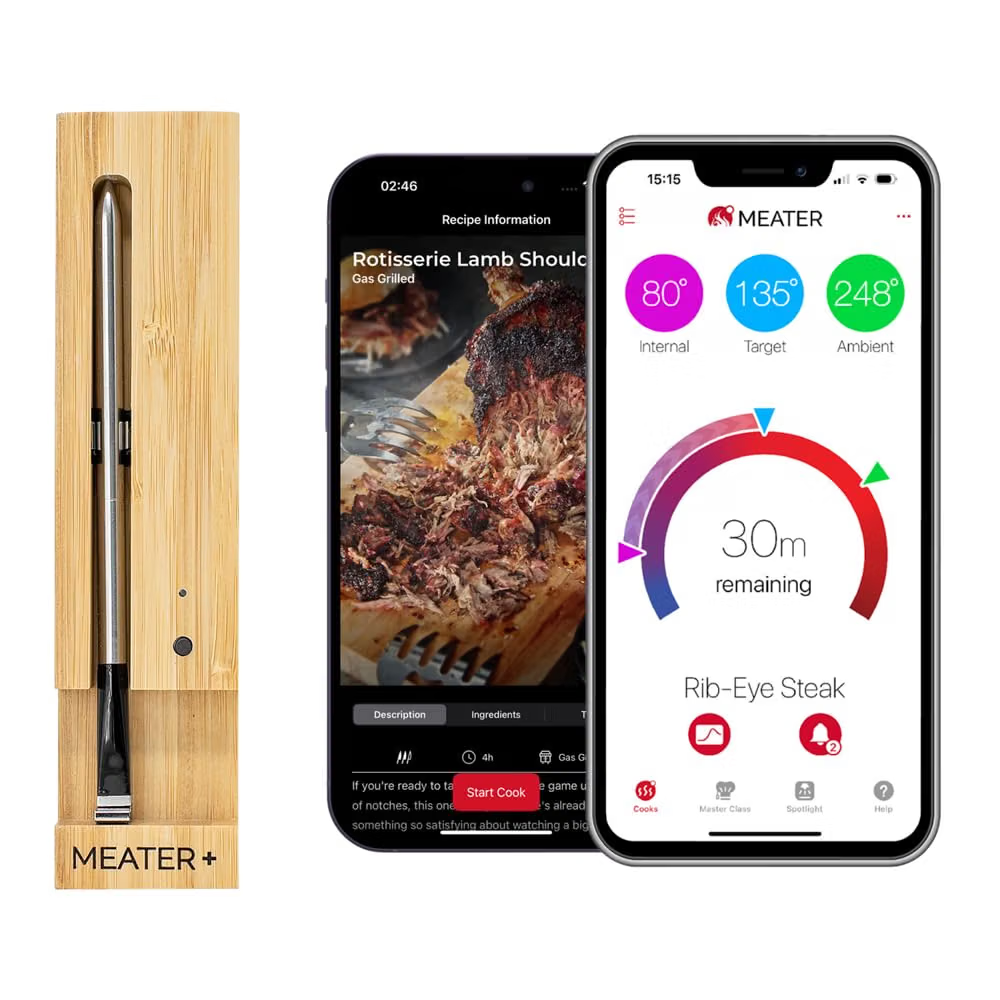
The MEATER Plus Smart Meat Thermometer is designed to make temperature monitoring more convenient by combining a wireless meat probe with a smartphone-connected cooking system. The product is listed in a Honey finish and is designed for use with grills, ovens, and other suitable cooking environments. Its advertised Bluetooth connectivity range reaches up to 165 feet under specified conditions.
Unlike a traditional instant-read thermometer, a wireless probe can remain inserted in the food while it cooks. This means the cook can monitor temperature without repeatedly opening an oven door, lifting a grill lid, or inserting a thermometer into the meat several times.
That distinction is important. An instant-read thermometer is useful when a quick measurement is needed, while a leave-in wireless thermometer is intended for ongoing monitoring throughout the cooking process.
The MEATER Plus approach also connects temperature information with a smartphone or compatible device. This can provide a more convenient way to follow cooking progress, depending on the application’s supported features and the user’s setup.
For home cooks, the appeal of this type of thermometer is not simply wireless connectivity. It is the ability to separate temperature monitoring from physically standing beside the cooking appliance. That can be useful when preparing foods that take a considerable amount of time or require attention to other parts of a meal.
This guide explains how a smart meat thermometer such as the MEATER Plus can fit into different cooking routines. It looks at its main features, practical applications, temperature-monitoring concepts, connectivity considerations, food-safety issues, and the differences between wireless probes, traditional instant-read thermometers, oven thermometers, and other temperature-monitoring tools.
Understanding the MEATER Plus Smart Meat Thermometer
The MEATER Plus is a wireless smart meat thermometer built around a probe that is inserted into food while it cooks.
The probe measures temperature inside the food and communicates information wirelessly to a compatible smartphone or other supported device through the MEATER system.
This type of setup changes how cooks interact with temperature measurements.
With a traditional thermometer, the process usually involves opening the oven, grill, or smoker and physically checking the food. With a wireless leave-in probe, temperature information can be monitored while the food remains in the cooking environment.
That can be particularly useful for longer cooking sessions.
The product is marketed for applications such as grilling and oven cooking, while the wireless design can also be useful in other compatible cooking situations where the probe’s operating requirements are respected.
One important distinction is that wireless does not mean unlimited range. The advertised 165-foot Bluetooth range should be understood as a stated maximum under suitable conditions rather than a guaranteed distance in every home or outdoor environment.
Walls, appliances, structures, interference, and the physical position of the devices can affect wireless performance.
Key Features
Wireless Meat Probe
The central component is the wireless probe.
A leave-in probe allows the temperature of the food to be monitored during cooking rather than requiring repeated manual measurements.
This can be helpful for foods that require gradual cooking. Instead of opening the cooking appliance repeatedly, the cook can monitor temperature through the connected system.
Keeping the cooking environment closed when appropriate can also help maintain more consistent cooking conditions. The practical benefit depends on the appliance and cooking method, but minimizing unnecessary opening of an oven or grill can be useful for temperature management.
Bluetooth Connectivity
The MEATER Plus uses Bluetooth connectivity to communicate temperature information.
Bluetooth is well suited to relatively short-range communication between nearby devices. The product’s advertised range is up to 165 feet, but actual range can vary.
For example, a wireless connection may behave differently when the probe is inside an oven, the receiving phone is in another room, or an outdoor grill is separated from the phone by walls or other structures.
The important lesson is to treat the published range as a reference point rather than a promise that the same distance will always be achievable.
Before a long cooking session, it can be useful to establish the connection and confirm that the monitoring device is receiving information reliably.
Smartphone-Based Monitoring
A smart thermometer can move temperature information from the cooking area to a smartphone.
This provides a familiar interface for viewing cooking progress rather than requiring a dedicated display attached directly to the probe.
The connected application can also provide information and controls supported by the MEATER system.
Smartphone-based monitoring can be particularly convenient during longer cooking sessions because the user can continue with other tasks while checking the cooking status periodically.
The exact application interface and available features may change as software is updated, so users should refer to the current MEATER app and product documentation for the latest functionality.
Advertised 165-Foot Range
The MEATER Plus is advertised with a wireless range of up to 165 feet.
Range specifications are typically measured under controlled or favorable conditions. Real-world performance can be lower.
Indoor environments are particularly variable because walls, floors, furniture, appliances, and other electronic equipment can affect wireless communication.
Outdoor cooking may provide fewer physical obstructions, although distance and environmental conditions still matter.
For most household cooking situations, the useful question is not whether the device can reach exactly 165 feet. Instead, consider whether the expected cooking location and monitoring location can maintain a reliable connection.
Grill and Oven Use
The thermometer is designed for cooking applications including grills and ovens.
This makes it relevant to several common cooking methods, from roasting poultry to grilling steaks and other meat.
Different appliances produce different thermal environments, however. Users should always follow the manufacturer’s operating instructions and temperature limits for the probe.
A thermometer designed for oven or grill use should not automatically be assumed to be suitable for every cooking technique.
Internal and Cooking-Environment Temperature Concepts
A meat thermometer can provide valuable information because it focuses on temperature rather than cooking time alone.
Internal meat temperature can vary depending on the thickness of the food, starting temperature, cooking method, heat intensity, and other factors.
Some smart thermometer systems also provide information about the surrounding cooking environment. Users should understand the difference between the temperature inside the food and the temperature around the probe.
These measurements answer different questions.
The internal temperature helps indicate how the center of the food is progressing. Ambient temperature can provide information about the cooking environment surrounding the food.
Both can be useful, but neither should be interpreted without considering the cooking method.
Why Internal Temperature Matters
Cooking meat based only on time can be unpredictable.
A recipe might suggest cooking a roast for a particular number of minutes per pound, for example, but actual results can vary because ovens, grills, food thickness, starting temperature, and other conditions differ.
Internal temperature provides a direct measurement of what is happening inside the food.
This is particularly important with thick cuts. The exterior can brown relatively quickly while the center remains at a lower temperature.
The opposite can also occur if food is cooked for too long.
A thermometer therefore gives the cook an additional source of information that complements visual cues, recipe instructions, and cooking experience.
For food safety, temperature should be interpreted using reliable food-safety guidance appropriate to the particular food. Recommended safe temperatures vary by food type and preparation method, so users should not rely on a single temperature for every type of meat.
How It Can Be Used
Grilling Steaks
A wireless thermometer can be useful when grilling thicker steaks.
The probe can remain in the meat while it cooks, allowing the internal temperature to be monitored without repeatedly cutting into the steak.
This can help the cook understand how quickly the internal temperature is changing.
Grilling involves intense direct heat, so probe placement matters. The probe should be positioned according to the manufacturer’s instructions, avoiding contact with bone where applicable and ensuring that the probe is properly inserted into the thickest relevant portion of the food.
Cooking Chicken
Poultry benefits from careful temperature monitoring.
Chicken can develop a browned exterior before the thickest part reaches the temperature required for safe preparation.
A leave-in probe allows the cook to monitor the internal temperature as cooking progresses.
For larger chicken pieces or whole poultry, placement becomes especially important. The thickest part of the meat is generally more informative than a thin edge.
Food-safety recommendations should be followed for the specific poultry being prepared.
Roasting Beef
Roasts are another natural application.
A large piece of beef can take considerable time to cook, and opening the oven repeatedly can be inconvenient.
A wireless probe provides continuous information while the roast remains in the oven.
For recipes involving a particular target internal temperature, monitoring the temperature can make it easier to determine when the roast is approaching the desired cooking stage.
The cook should also account for carryover cooking. Some foods continue to rise in internal temperature after being removed from the heat source.
Cooking Pork
Pork dishes can also benefit from internal temperature monitoring.
Whether preparing a pork loin, roast, or another suitable cut, the thermometer can provide information about the center of the food without requiring repeated probing.
The correct target depends on the specific food and preparation method, so current food-safety guidance and recipe instructions should be considered together.
Longer Cooking Sessions
Wireless monitoring becomes particularly useful when cooking takes a long time.
Smoking, slow roasting, and other low-and-slow techniques may require extended cooking periods. Constantly opening the cooking appliance to check the food can be inconvenient.
A connected thermometer allows the cook to monitor temperature without physically disturbing the food every few minutes.
This can make long cooking sessions easier to manage, particularly when the user needs to move around the house or prepare other dishes.
Holiday and Family Meals
Large meals often involve several cooking tasks at once.
A wireless thermometer can provide temperature information while the cook works on side dishes, sauces, preparation, or serving.
The advantage is organizational as much as technological. Having temperature information available on a smartphone can help the cook coordinate multiple tasks.
Outdoor Cooking
Grilling outdoors creates situations where a wireless thermometer can be particularly convenient.
The cook may not want to remain directly beside the grill throughout the entire cooking period.
A connected probe can allow temperature monitoring from a nearby location, provided the wireless connection remains stable.
Outdoor structures and distance can still affect Bluetooth performance, so it is sensible to test connectivity before relying on remote monitoring.
Probe Placement Matters
Even a sophisticated thermometer can provide misleading information if it is positioned incorrectly.
The probe should generally be inserted into the thickest appropriate part of the food, depending on the specific food and manufacturer’s instructions.
Bone can conduct heat differently from surrounding meat, so placing the sensing area directly against a bone can affect the reading.
Very thin foods can also present challenges because the probe may extend too close to the cooking surface.
Correct placement is therefore an essential part of using any leave-in thermometer.
Users should follow the manufacturer’s instructions for probe insertion, minimum insertion depth, maximum temperatures, and suitable cooking environments.
Who It May Be Suitable For
Frequent Home Cooks
People who regularly cook meat may find continuous temperature monitoring useful.
Instead of repeatedly switching between cooking and checking the food, they can monitor temperature as part of the overall cooking process.
Grill Users
People who regularly use outdoor grills can benefit from being able to monitor internal temperature without constantly lifting the grill lid.
This can be especially useful when cooking thicker cuts or several pieces at once.
Oven Cooks
Home cooks who frequently prepare roasts, poultry, or other large dishes may appreciate the convenience of a leave-in probe.
The thermometer can remain in position while the food cooks.
People Who Cook Large Cuts
Large roasts and thick cuts tend to take longer to cook and can have greater differences between exterior and interior temperature.
Continuous monitoring can provide more information during these longer cooking periods.
People Interested in Connected Kitchen Technology
The MEATER Plus may also appeal to users who enjoy integrating smartphones and connected devices into everyday cooking.
The advantage of this approach is not simply the presence of an app. It is the ability to bring cooking information into a device the user already understands.
Important Things to Consider
Bluetooth Range Is Not Guaranteed
The advertised 165-foot range should not be interpreted as a guaranteed indoor distance.
Bluetooth performance is affected by the environment.
A phone located behind multiple walls may have a different connection experience from one positioned nearby with a clear path.
For important cooking sessions, test the expected setup before leaving the thermometer unattended.
Battery and Charging
Wireless cooking equipment depends on battery power.
Before starting a long cook, users should make sure the probe and associated components have adequate charge according to the manufacturer’s instructions.
A depleted battery during a long roast could interrupt temperature monitoring.
Charging habits therefore become part of using a wireless thermometer reliably.
High-Temperature Limits
Wireless probes are designed for specific temperature ranges.
Users should not assume that a probe can be exposed to unlimited temperatures simply because it is marketed for grills and ovens.
Certain cooking methods can expose equipment to extremely high heat, particularly when using direct flames or specialized grill techniques.
Always follow the product’s published operating and temperature limits.
Food Safety and Hygiene
The probe comes into direct contact with food, so hygiene is important.
Clean it according to the manufacturer’s instructions after each appropriate use.
Avoid cross-contamination between raw and cooked food. If the probe is used with raw meat and then needs to be inserted into cooked food, it should be properly cleaned and sanitized according to appropriate food-safety practices.
A thermometer is a food-contact tool and should be treated accordingly.
Cleaning Requirements
Wireless electronics require more careful cleaning than a simple metal thermometer.
The probe should be cleaned using the method specified by the manufacturer. Users should not automatically immerse electronic components in water unless the manufacturer explicitly states that the component is designed for that treatment.
Proper maintenance can help protect the equipment and reduce the risk of contamination.
Smartphone Dependence
A smart thermometer provides additional convenience through a connected device, but this also introduces dependencies.
The smartphone needs sufficient battery power, the application needs to function properly, and wireless connectivity needs to remain available.
This is different from a basic instant-read thermometer, which can often operate independently without an app.
App and Software Updates
Connected kitchen devices can evolve through software updates.
The available app interface, supported features, notifications, and integrations may change over time.
Users should keep the relevant application updated and consult current documentation when a feature behaves differently from an earlier version.
Temperature Accuracy
No thermometer should be treated as infallible.
Sensor readings can be affected by placement, temperature gradients within the food, environmental conditions, and the characteristics of the food itself.
If a temperature measurement is critical, proper probe placement and appropriate verification practices become especially important.
Comparing General Temperature-Monitoring Categories
Wireless Smart Thermometer vs. Instant-Read Thermometer
An instant-read thermometer is designed for quick measurements.
It can be inserted into food, checked, and removed. This makes it useful for cooks who prefer manually checking food at particular stages.
A wireless thermometer is designed for continuous monitoring.
The main difference is therefore workflow. One emphasizes quick manual checks, while the other emphasizes ongoing monitoring.
Some cooks may find that the two categories complement one another.
Wireless Thermometer vs. Oven Thermometer
An oven thermometer generally measures the temperature of the cooking environment.
It can help identify whether an oven’s actual temperature corresponds reasonably well to its setting.
A meat thermometer measures the temperature of the food itself.
These are different measurements. An oven can be at the correct temperature while the center of a roast is still below the desired internal temperature.
For that reason, the tools should not be considered interchangeable.
Wireless Thermometer vs. Traditional Leave-In Probe
Traditional leave-in thermometers can remain inserted into food during cooking, but the display is often physically connected to the probe or positioned near the cooking appliance.
A wireless smart thermometer separates the probe from the viewing device.
This can provide greater flexibility because the cook can monitor information from a smartphone rather than standing next to a display.
The trade-off is greater dependence on batteries, wireless communication, and software.
Wireless Thermometer vs. Cooking by Time
Cooking by time remains common and can work well when recipes and conditions are consistent.
However, time alone does not account for every variable affecting internal temperature.
A thermometer adds a direct measurement that can help the cook understand what is actually happening inside the food.
The two approaches can be used together: recipe timing provides a general expectation, while internal temperature provides additional information.
Practical Tips for Better Temperature Monitoring
Before cooking, make sure the probe is charged and clean.
Check the connection between the probe and the monitoring device before placing the food in the cooking appliance.
Position the probe carefully according to the manufacturer’s instructions.
For thick cuts, aim to measure the temperature in the portion that best represents the center of the food.
Avoid relying exclusively on a single reading if the food has an unusual shape or if temperature distribution is likely to vary.
When cooking large pieces, remember that internal temperature can continue changing after the food is removed from the heat.
Use reliable food-safety guidance for the specific food being prepared rather than applying one universal target temperature to every recipe.
After cooking, clean and store the probe according to the manufacturer’s recommendations.
These simple habits can make a smart thermometer more useful while reducing common sources of inaccurate readings or interrupted monitoring.
Understanding Carryover Cooking
One concept worth understanding when using any meat thermometer is carryover cooking.
Food does not necessarily stop changing temperature the instant it is removed from the heat.
The exterior can remain hotter than the center, allowing heat to continue moving inward. As a result, the internal temperature can rise for a period after cooking ends.
The amount of carryover cooking varies according to factors such as food size, shape, cooking method, and temperature.
For recipes that depend on a particular internal temperature, cooks should consider the expected temperature change after removal from the heat.
This is another reason why a thermometer can be more informative than cooking time alone.
Using Temperature Information as Part of a Larger Cooking Process
A thermometer does not replace cooking knowledge.
It works best as one source of information among several.
Visual appearance, recipe instructions, cooking time, texture, resting time, and internal temperature can all contribute to the final result.
For food safety, temperature measurements should be interpreted according to recognized food-safety recommendations.
For culinary purposes, the target temperature may depend on the particular recipe and desired preparation.
The advantage of a connected thermometer is that it makes one of those information sources—temperature—available continuously.
Frequently Asked Questions
What is the MEATER Plus Smart Meat Thermometer?
The MEATER Plus is a wireless smart meat thermometer designed to monitor the temperature of food during cooking. It uses a probe and Bluetooth connectivity to provide temperature information through a compatible device.
How far can the MEATER Plus connect?
The product is advertised with Bluetooth connectivity of up to 165 feet. Actual range can vary depending on walls, interference, appliance placement, distance, and other environmental conditions.
Can the MEATER Plus be used in an oven?
It is designed for compatible oven cooking applications. Users should follow the manufacturer’s instructions regarding probe placement, operating temperatures, and suitable cooking environments.
Can it be used on a grill?
Yes, the MEATER Plus is designed for grill use. However, users should follow the specified temperature and exposure limits and avoid situations that exceed the probe’s intended operating conditions.
Does the thermometer stay inside the meat while cooking?
The MEATER Plus is designed as a leave-in wireless probe, allowing temperature monitoring while the food cooks. Correct insertion and positioning are important for meaningful readings.
Does the MEATER Plus require a smartphone?
The smart features are designed around connection with a compatible device and the MEATER application. Users should check the current system requirements to confirm compatibility with their particular smartphone.
Can the thermometer monitor temperature remotely?
It can provide wireless monitoring within its supported connection range. The practical distance depends on the environment, so users should not assume that the maximum advertised range will always be available.
Is the MEATER Plus suitable for chicken?
A wireless meat thermometer can be useful for monitoring poultry because internal temperature is an important part of safe preparation. Users should follow current food-safety guidance for the particular chicken dish.
Can it be used for large roasts?
Yes, large roasts are a common type of food where continuous internal temperature monitoring can be useful. Probe placement should be chosen carefully so the measurement represents the appropriate part of the roast.
Why is internal temperature more useful than cooking time alone?
Cooking time can vary depending on food size, thickness, starting temperature, cooking appliance, and other conditions. Internal temperature provides a direct measurement of the food’s thermal state.
Can a meat thermometer measure oven temperature?
A meat thermometer and an oven thermometer serve different purposes. A meat thermometer primarily monitors food temperature, while an oven thermometer is intended to measure the surrounding cooking environment.
How should the MEATER Plus probe be cleaned?
Cleaning should follow the manufacturer’s instructions for the specific probe and components. Because the system contains electronic components, users should avoid cleaning methods that are not approved for the product.
Does Bluetooth range work the same indoors and outdoors?
No. Walls, floors, furniture, appliances, and other obstacles can reduce wireless range. Outdoor conditions may be different, but distance and interference can still affect the connection.
Is a wireless meat thermometer useful for slow cooking?
It can be particularly useful for longer cooking sessions because the probe can remain in the food while the temperature is monitored over time.
Conclusion
The MEATER Plus Smart Meat Thermometer combines a wireless leave-in probe with smartphone-based temperature monitoring, creating a different cooking workflow from a traditional instant-read thermometer.
Its advertised Bluetooth range of up to 165 feet can provide flexibility for monitoring cooking progress, although actual wireless performance depends on the surrounding environment. The system is designed for applications including grilling and oven cooking, making it relevant to steaks, poultry, roasts, pork, and other suitable foods.
The central benefit of this category of thermometer is continuous access to internal temperature information. Rather than relying exclusively on cooking time or repeatedly opening an oven or grill, the cook can monitor how the food is progressing while it remains in the cooking environment.
At the same time, wireless technology introduces considerations that do not apply to every traditional thermometer. Battery charge, Bluetooth connectivity, smartphone compatibility, software, probe placement, cleaning, and temperature limits all become part of the overall setup.
For home cooks who regularly prepare meat and want a more connected approach to temperature monitoring, a wireless smart thermometer can become a practical part of the kitchen workflow. It is not a replacement for sound cooking practices or food-safety guidance, but it can provide another useful measurement when timing and visual inspection alone are not enough.
As with any cooking tool, the most reliable results come from understanding how the equipment works and using it within its intended limits. Checking the latest manufacturer’s instructions and compatibility information is a sensible step before use.
Leave a Reply