Introduction
Keeping track of vehicles and equipment can be difficult when they are regularly parked in different locations, moved between work sites, or used by multiple people. Cars, trucks, motorcycles, trailers, tools, and other equipment can spend long periods away from their owner, making a simple location reference useful when it is time to find them.
Bluetooth tracking tags offer one approach to this problem. Rather than using a conventional cellular GPS tracking service, these small devices are designed to work with a compatible smartphone ecosystem and help users locate tagged objects.
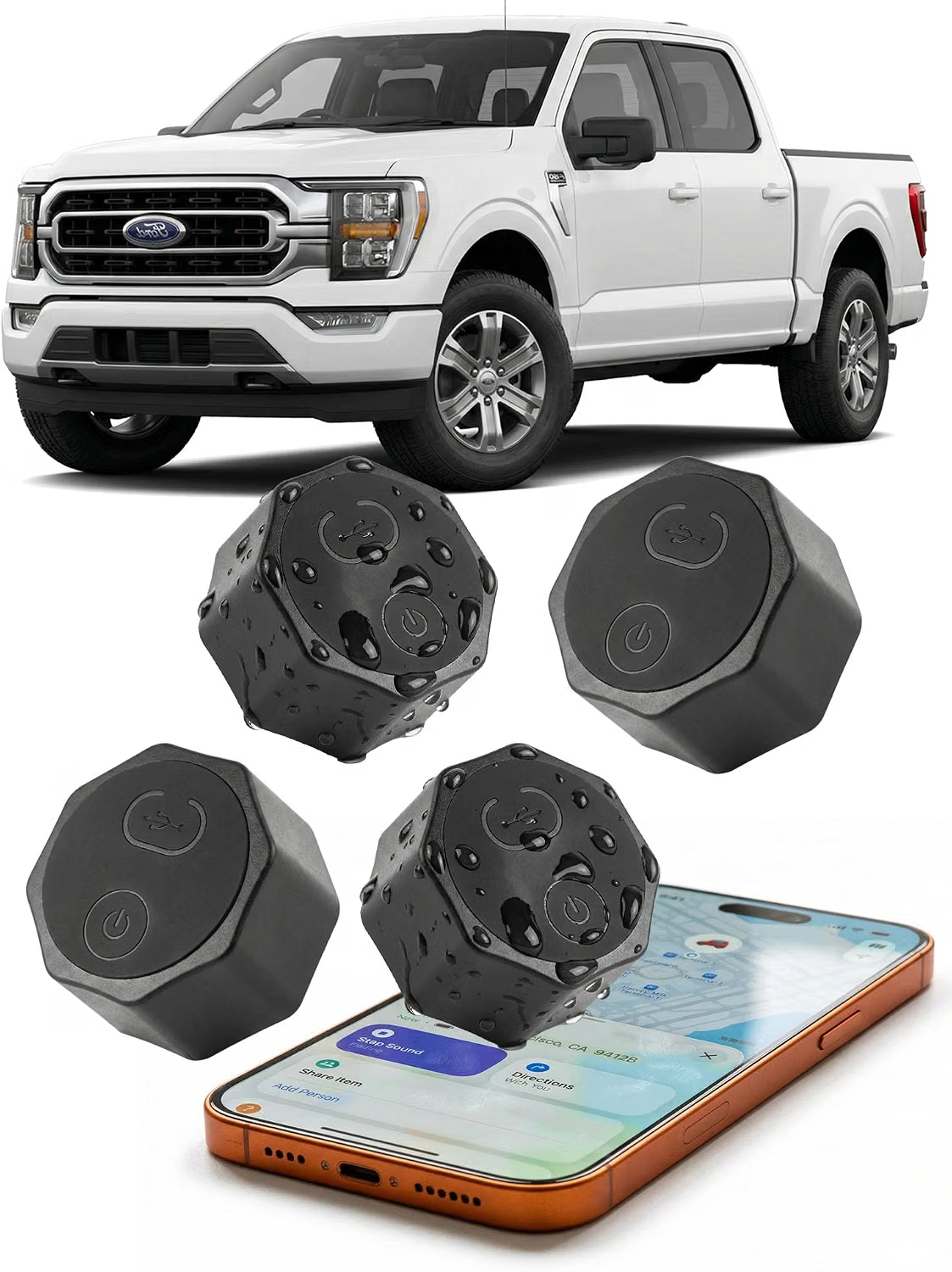
The Air Tracker Tag Hidden Ultra Magnetic Finder for Vehicles is designed for this type of use. The product is described as a four-pack of black tracking tags that work with Apple’s Find My network and are intended for iOS users. Its listed features include a magnetic design, no monthly fee, and a claimed five-year battery life.
These characteristics make the product particularly relevant to people who want to add tracking capability to personal vehicles or equipment without installing a traditional wired GPS tracking system.
There is an important distinction to understand, however. A Find My-compatible Bluetooth tracker is not the same technology as a dedicated GPS vehicle tracker. It does not continuously determine its own position through GPS satellites and does not necessarily provide a live location every second. Instead, its location capabilities depend on Bluetooth communication and the participating Apple Find My network.
That difference affects where and how the device should be used.
For a privately owned car parked in a large parking lot, a motorcycle stored away from home, or equipment that is frequently moved between locations, a tracker can provide useful additional location information. At the same time, it should not be treated as a substitute for physical security, insurance, a professionally installed fleet-management system, or an emergency-response device.
The product’s iOS-only compatibility is another important consideration. Users need a compatible Apple device and access to the supported Find My ecosystem. Android users should not assume that the same tracking functionality will be available.
This guide explores the product as a vehicle and equipment tracking accessory. It explains the main features, practical applications, battery considerations, magnetic mounting, Apple Find My functionality, privacy and responsible-use issues, limitations of Bluetooth tracking, and the differences between this type of tracker and GPS-based systems.
What Is an Air Tracker Tag for Vehicles?
An Air Tracker Tag is a compact tracking accessory designed to help locate an attached object through Apple’s Find My ecosystem.
The version discussed here is marketed specifically for applications such as:
- Cars
- Trucks
- Motorcycles
- Equipment
- Other suitable personal belongings
It is supplied as a four-pack, which allows multiple vehicles or pieces of equipment to be tracked independently.
The product is described as an iOS-only accessory. That means its intended operation is centered around Apple’s Find My system rather than a general-purpose Android tracking application.
The magnetic design is another distinguishing characteristic. A magnetic tracker can potentially be positioned on a suitable metal surface without requiring permanent installation.
This can make the device easier to move between equipment or position discreetly on a compatible personal asset.
However, “magnetic” does not mean that every surface is suitable. Aluminum, plastic, fiberglass, painted surfaces, irregular shapes, and other materials may not provide the same attachment conditions as a flat steel surface.
Users should also follow the manufacturer’s guidance regarding where the tracker can safely be attached.
Key Features
Apple Find My Compatibility
The product is designed to work with Apple’s Find My ecosystem.
Find My provides an established environment for locating compatible Apple devices and accessories. A compatible third-party tracker can use this ecosystem to provide location information for a tagged object.
For an iPhone user, this can make the tracker easier to incorporate into an existing Apple setup.
The important point is that the tracker depends on supported Apple functionality. Users should follow the current product setup instructions and confirm compatibility with their specific iPhone and iOS version.
Software requirements can change, so compatibility information should be checked before installation.
iOS Only
The product is explicitly described as iOS only.
This is one of the first specifications prospective users should consider.
Someone who uses an Android smartphone should not assume that the tracker can be configured and managed in the same way.
An iPhone or another supported Apple device is part of the intended system.
For households where some people use iPhones and others use Android phones, it is worth deciding in advance who will manage the tracker and its associated Find My account.
Four-Pack Configuration
The product comes as a four-pack.
A multi-pack can be useful when several vehicles or pieces of equipment need location assistance.
For example, a household could assign individual tags to a car, motorcycle, trailer, and equipment case.
A small business owner might use separate tags for selected personal equipment, although professional fleet management may require a different type of tracking system.
Each tracker should be clearly associated with a particular item so that the Find My app remains organized.
Magnetic Attachment
The tracker is designed with a magnetic mounting concept.
This can simplify installation on suitable metal surfaces because it may not require drilling, wiring, or permanent adhesive.
Magnetic mounting can also make it possible to remove or reposition a tracker without permanently modifying the vehicle or equipment.
The attachment should nevertheless be tested carefully.
A tracker attached to a vehicle may experience vibration, temperature changes, moisture, dust, and movement. A magnet that feels secure while a vehicle is stationary may not necessarily remain secure during long periods of driving.
Users should follow the manufacturer’s mounting recommendations and periodically check the attachment.
No Monthly Fee
The product description identifies the tracker as having no monthly fee.
This distinguishes it from many cellular GPS tracking systems that require a recurring data or subscription plan.
A Bluetooth tracker based on Apple’s Find My ecosystem does not operate in exactly the same way as a cellular GPS tracker, which is one reason its ongoing service requirements can be different.
“No monthly fee” should not be interpreted as meaning that every Apple service, device, subscription, or related feature is free in every circumstance. Users should review the current terms associated with the Apple Find My ecosystem and any services they choose to use.
Five-Year Battery Claim
The product is advertised with a five-year battery life.
Long battery life can be particularly useful for a tracker attached to equipment or a vehicle because frequent charging would be inconvenient.
A longer stated battery life can reduce maintenance requirements, but actual battery performance can vary according to operating conditions, usage, environmental temperature, battery characteristics, and other factors.
The five-year figure should therefore be treated as the manufacturer’s stated claim rather than a guarantee that every unit will operate for exactly five years.
Users should also verify whether the battery is replaceable and follow the manufacturer’s instructions for battery maintenance.
Compact Vehicle-Oriented Form
A vehicle tracking accessory needs to be small enough to attach without interfering with normal use.
The compact form of this type of tracker allows it to be considered for vehicles and equipment where a larger GPS unit may be inconvenient.
The tracker should never be installed where it can interfere with steering, braking, pedals, visibility, doors, engine components, safety equipment, or other critical vehicle systems.
How It Can Be Used
Personal Cars
A personal car is one of the most straightforward applications.
A tracker can provide an additional way to locate the vehicle if the owner forgets where it was parked.
For example, after leaving a vehicle in a large parking area, the Find My system can help the user determine its available location information.
The tracker can also be useful when a vehicle is regularly parked in different locations.
It should not, however, be considered a replacement for a professionally installed anti-theft or vehicle-security system.
Trucks
Work trucks can travel between homes, offices, construction sites, and other locations.
A tracker attached to a suitable part of a privately owned truck can provide another way to identify its location through the Find My ecosystem.
The mounting location should be selected carefully to avoid excessive heat, water exposure, vibration, or mechanical interference.
Motorcycles
Motorcycles can also benefit from compact tracking accessories.
Their smaller size and lack of enclosed storage can make conventional equipment placement more challenging.
A magnetic tracker can provide installation flexibility when an appropriate metal mounting surface is available.
Because motorcycles experience vibration, weather exposure, and temperature variation, attachment security should receive particular attention.
The tracker should not be positioned where it can interfere with steering, suspension, controls, moving components, or maintenance access.
Trailers
Trailers can be separated from their towing vehicle and may remain parked for extended periods.
A tracking tag can provide an additional locating mechanism for a privately owned trailer.
Users should choose a secure mounting location that protects the device while maintaining a reliable attachment.
Outdoor Equipment
Equipment used outdoors can be difficult to keep track of when it moves between locations.
Depending on the size and material of the equipment, a tracker may be attached to suitable metal surfaces.
Possible applications can include certain tools, machinery cases, recreational equipment, or other personal assets.
The exact suitability depends on the physical environment and the tracker’s environmental specifications.
Storage Equipment
A tracker can also be used for equipment stored in garages, workshops, storage units, or other locations.
If an item is moved, the Find My ecosystem may provide updated location information when the tracker communicates with the network.
This can be useful for people who maintain several storage locations.
Camping and Recreational Equipment
Owners of recreational equipment may use tracking tags as an additional organizational tool.
For example, a tracker might be attached to a suitable equipment case, trailer, or other personal asset.
Again, the tracker should not be treated as a security guarantee.
Understanding Apple Find My Tracking
The Find My system is central to understanding how this type of product works.
A Bluetooth tracker does not normally determine its location independently using GPS.
Instead, it communicates using Bluetooth and can use compatible devices participating in Apple’s Find My network to help report its location.
This creates an important distinction between direct Bluetooth tracking and network-assisted location.
When a tagged object is nearby, the owner’s compatible Apple device may be able to communicate with the tracker directly.
When the object is farther away, another compatible Apple device participating in the Find My network may detect the tracker and relay location information through the network.
This does not mean that the tracker continuously broadcasts a live GPS position.
The available location information depends on network interactions and other technical conditions.
For that reason, users should think of the tracker as an object-finding accessory rather than a conventional real-time vehicle telemetry system.
Bluetooth Tracking vs. GPS Tracking
This distinction is particularly important when a tracker is marketed for vehicles.
A GPS vehicle tracker typically contains a GPS receiver and another communication method, such as cellular connectivity. It can be designed to determine and transmit the vehicle’s location independently.
A Bluetooth tracker follows a different model.
It is smaller and can often operate for much longer periods on a small battery, but it does not necessarily provide continuous real-time vehicle location.
GPS tracking can be appropriate for:
- Fleet management
- Vehicle telemetry
- Continuous location monitoring
- Certain commercial applications
- Systems requiring dedicated cellular connectivity
Bluetooth tracking can be appropriate for:
- Finding a parked personal vehicle
- Locating motorcycles
- Finding equipment
- Tracking bags and cases
- Recovering misplaced belongings
- Adding another layer of awareness to personal property
The choice depends on what type of information the user actually needs.
Who It May Be Suitable For
iPhone Users
The product is primarily intended for people using compatible Apple devices.
The iOS-only design makes Apple compatibility essential.
Users should verify current iOS and device requirements before setup.
Owners of Multiple Vehicles
A four-pack can be useful for people who own or manage several personal vehicles.
Different tags can be associated with different vehicles while being managed through the same compatible ecosystem.
Motorcycle Owners
A small tracker can provide another locating method for a motorcycle, particularly when it is regularly parked away from home.
The mounting method should be carefully evaluated because motorcycles are exposed to vibration and weather.
People With Expensive Equipment
Equipment cases, tools, recreational equipment, and other personal assets can be difficult to monitor when moved between locations.
A tracker can provide another source of location information.
Travelers
A tracker can also be used on suitable travel equipment or luggage, assuming the physical attachment and environmental conditions are appropriate.
People Who Do Not Want a Cellular Subscription
Users who do not need continuous GPS monitoring may prefer a Bluetooth-based approach that does not require a recurring cellular tracking plan.
The trade-off is that the location system operates differently from a dedicated GPS device.
Important Things to Consider
No Monthly Fee Does Not Mean No Technology Requirements
A tracker may not require a recurring subscription while still depending on an Apple device, software, Bluetooth, network access, and the Find My ecosystem.
Users should understand the complete system rather than evaluating it only by whether there is a monthly charge.
Battery Life Is an Estimate
The advertised five-year battery life is an important product specification, but actual battery performance can vary.
Temperature is particularly relevant to batteries. Vehicles can become extremely hot or cold depending on weather and parking conditions.
Battery performance can also change as the battery ages.
Users should monitor the tracker and replace the battery according to the manufacturer’s instructions if the design permits replacement.
Magnetic Attachment Requires Care
A magnetic mount is convenient, but it creates an important responsibility: ensuring that the tracker stays attached.
Vehicle movement introduces vibration and acceleration that do not occur when an item is sitting on a table.
The tracker should therefore be installed on an appropriate surface and checked periodically.
If the tracker falls off, the location information may no longer correspond to the vehicle.
Weather Exposure
Vehicle-mounted accessories can encounter rain, humidity, dust, road spray, and temperature extremes.
Users should verify the tracker’s environmental and water-resistance specifications before placing it in an exposed location.
Do not assume that a magnetic tracker is automatically waterproof simply because it is designed for vehicle use.
Heat
Vehicles can become significantly hotter than the surrounding outdoor temperature when parked in direct sunlight.
Areas near engines, exhaust components, radiators, or other heat sources can be even more demanding.
The tracker should be placed according to its rated operating conditions.
Avoid locations exposed to excessive heat unless the manufacturer specifically identifies them as suitable.
Do Not Interfere With Vehicle Systems
A tracking accessory should never interfere with the safe operation of a vehicle.
Avoid placing it near:
- Brake components
- Steering components
- Pedals
- Airbag systems
- Moving belts
- Fans
- Suspension components
- Engine mechanisms
- Electrical connections
- Exhaust components
- Driver visibility
The tracker should be an independent accessory rather than something integrated into a critical vehicle system.
Find My Is Not the Same as Continuous Vehicle Tracking
This is perhaps the most important limitation.
If the purpose is to monitor a vehicle’s movements continuously, a Bluetooth tracker may not provide the type of information required.
A dedicated GPS/cellular solution may be more appropriate for fleet operations or applications requiring continuous location reporting.
Network Availability
Network-assisted location depends on participating Apple devices being available to detect the tracker.
A tracker in a busy city may encounter more participating devices than one in a remote area.
The system’s ability to update a location can therefore vary depending on where the tagged object is located.
Privacy and Consent
Tracking technology should be used responsibly.
The appropriate application is tracking property that you own or have permission to track.
Using a hidden tracker to monitor another person’s vehicle or movements without their knowledge can create serious privacy and legal concerns.
The fact that a tracker can be mounted discreetly does not remove those responsibilities.
For shared vehicles, family vehicles, employee-operated vehicles, or borrowed equipment, users should consider applicable laws, organizational policies, and the expectations of the people involved.
Theft Recovery Expectations
A tracker may provide useful location information if a vehicle or item goes missing, but it should not be viewed as a guaranteed theft-recovery system.
Location information may be delayed, unavailable, or inaccurate for practical reasons.
If a tracker provides information about a potentially stolen vehicle, users should avoid confronting suspected individuals themselves and should contact the appropriate authorities.
Regional and Software Availability
Apple’s Find My functionality and compatible accessory support can depend on device software and regional factors.
Users should verify the current requirements before relying on the tracker for an important application.
Vehicle Tracking vs. Equipment Tracking
The product’s four-pack format makes it suitable for thinking about tracking as a broader asset-management tool.
A household could use four tags for four different categories.
For example:
Tag 1: Primary vehicle
Tag 2: Motorcycle
Tag 3: Trailer
Tag 4: Equipment case
This creates a simple organizational system.
For larger collections of commercial equipment, however, consumer Bluetooth trackers may not provide enough information. Businesses may require systems with asset databases, cellular connectivity, GPS reporting, geofencing, maintenance records, and administrative controls.
The scale of the tracking problem should therefore determine the technology.
Air Tracker Tag vs. Dedicated GPS Vehicle Tracker
A dedicated GPS tracker is designed specifically for location monitoring.
It may provide features such as:
- GPS positioning
- Cellular communication
- Location history
- Geofencing
- Movement alerts
- Continuous or scheduled reporting
The exact features depend on the product.
The trade-off is that GPS systems can require charging, wiring, cellular service, or recurring fees.
A Bluetooth Find My-compatible tracker is generally simpler.
It can operate as an accessory without being wired into the vehicle and may have a substantially longer battery life.
The two categories are therefore designed around different priorities.
Air Tracker Tag vs. Traditional Anti-Theft Device
An anti-theft system is intended to deter unauthorized access or help prevent a vehicle from being operated without authorization.
A tracking tag does something different.
It provides location information.
A tracker does not physically prevent someone from entering or moving a vehicle.
For vehicle security, tracking and physical or electronic anti-theft measures can serve separate purposes.
Air Tracker Tag vs. Smartphone Find My
Apple’s Find My service can locate certain Apple devices directly.
A vehicle or equipment case generally does not have an Apple operating system of its own.
A compatible tracker effectively gives an otherwise offline object a connection to the Find My ecosystem.
That is why a small tracking tag can be useful for belongings that cannot run the Find My application themselves.
Air Tracker Tag vs. Traditional Key Finder
A basic key finder may use a local Bluetooth connection and a companion application.
A Find My-compatible tracker can potentially benefit from Apple’s broader network of participating devices.
The trade-off is that the tracker becomes dependent on Apple’s ecosystem and iOS compatibility.
For users already invested in Apple devices, that ecosystem may be convenient. For Android users, another tracking platform may be more appropriate.
Practical Installation Considerations
Before attaching a tracker to a vehicle, identify the type of surface available.
A flat metal surface may provide a better magnetic attachment than plastic or composite body panels.
Consider exposure to water, heat, vibration, road debris, and maintenance activities.
Avoid locations where mechanics may routinely remove components or where the tracker could fall into a moving part.
After installation, test the connection while the vehicle is stationary.
If the tracker is intended to remain attached for a long period, periodically inspect the attachment.
This is especially important after severe weather, long-distance travel, or maintenance work.
Creating a Multi-Asset Tracking Routine
A four-pack can be more useful when the tags are organized systematically.
Give each tracker a clear name that describes the associated asset.
For example:
- Family Car
- Motorcycle
- Trailer
- Workshop Equipment
Avoid vague names that make it difficult to identify which tracker corresponds to which object.
If an item is sold, transferred, or replaced, remove the old association from the tracking system and configure the replacement appropriately.
Maintaining a clean digital list can prevent confusion over time.
Travel and Long-Term Storage
If a vehicle or piece of equipment will remain unused for several months, the tracker can potentially provide useful additional location awareness.
However, long-term storage creates special considerations.
Check battery condition before storage.
Consider whether the storage location provides suitable environmental conditions.
If the item is stored inside a metal structure or underground facility, Bluetooth and network-based communication may behave differently.
A tracker should not be relied upon as the only method of monitoring long-term stored property.
Responsible Use of Hidden Tracking Technology
The word “hidden” in a product description deserves careful consideration.
A small tracker can be positioned discreetly on one’s own property, which can be useful for protecting the appearance of a vehicle or avoiding accidental removal.
However, discreet placement does not make secret tracking of other people acceptable.
Tracking a partner’s, employee’s, neighbor’s, or another person’s vehicle without appropriate knowledge or authorization can create significant privacy concerns and may violate local law.
The safest approach is to use the tracker for property you own or have clear permission to track.
If a vehicle is shared by multiple people, transparency is preferable.
Frequently Asked Questions
What is an Air Tracker Tag for vehicles?
It is a compact Bluetooth tracking accessory designed to help locate compatible personal property through Apple’s Find My ecosystem.
Does it work with Android?
The product is described as iOS only. Android users should not assume that the same functionality is supported.
Does it work with Apple Find My?
Yes, the product is designed to work with Apple’s Find My ecosystem. Users should follow the current setup instructions and verify compatibility with their Apple device and software.
How many trackers are included?
The product is offered as a four-pack, allowing four separate assets to be assigned individual tracking tags.
Is the tracker a GPS device?
It should not be treated as a conventional GPS tracker. It is designed around Bluetooth communication and Apple’s Find My network rather than continuous GPS positioning.
Can it provide real-time vehicle tracking?
A Find My-compatible Bluetooth tracker should not be considered a continuous real-time vehicle tracking system. Location updates depend on Bluetooth communication and supported network interactions.
What is the claimed battery life?
The product is advertised with a five-year battery life. Actual battery performance can vary depending on operating conditions, temperature, usage, and battery characteristics.
Does the tracker require a monthly subscription?
The product description identifies it as having no monthly fee. Users should still consider the requirements of the Apple ecosystem and verify current service terms.
Can the tracker be attached to a car?
It is marketed for vehicle applications such as cars and trucks. The magnetic attachment should be placed on a suitable surface and secured according to the manufacturer’s instructions.
Can it be used on a motorcycle?
It is marketed for motorcycle applications. Because motorcycles experience vibration and weather exposure, users should pay particular attention to secure mounting and environmental specifications.
Can it be used on equipment?
Yes. The product is also described for equipment tracking. The equipment should provide a suitable location for secure attachment and remain within the tracker’s environmental limits.
Is magnetic mounting permanent?
No. Magnetic attachment is generally intended to allow the tracker to be positioned without permanent modification. Users should still verify that the attachment remains secure under real-world conditions.
Can the tracker be placed anywhere on a vehicle?
No. The location should be selected carefully. Avoid areas involving excessive heat, moving components, steering, braking, airbags, electrical systems, exhaust components, or other critical vehicle functions.
Can the tracker work inside a garage?
It may, depending on the location, materials, and network conditions. Metal structures and other physical barriers can affect wireless communication.
What happens if the tracker moves outside Bluetooth range?
Direct communication with the owner’s device may no longer be available. The Find My ecosystem can potentially provide updated location information when participating devices detect the tracker, but this is not guaranteed.
Can the tracker guarantee recovery of a stolen vehicle?
No. A tracker cannot guarantee recovery. It can potentially provide useful location information, but network availability, battery condition, communication, and other factors can affect what information is available.
Can I use the tracker to monitor another person’s vehicle secretly?
The appropriate use is tracking property that you own or have permission to track. Secretly monitoring another person’s movements can raise serious privacy and legal concerns.
Is a Bluetooth tracker better than a GPS tracker?
The two technologies serve different purposes. Bluetooth trackers are generally suited to finding personal belongings and providing network-assisted location information, while GPS/cellular trackers can be designed for more continuous vehicle monitoring.
Is the five-year battery life guaranteed?
No. It is an advertised battery-life claim. Actual performance can vary with environmental conditions, usage, battery characteristics, and other factors.
Does a magnetic tracker work on aluminum?
Magnetic attachment depends on the material and surface. Aluminum is not ferromagnetic, so a magnet generally will not attach to it in the same way it attaches to steel. Users should identify a suitable mounting surface before installation.
Should I rely on this tracker as my only vehicle security measure?
No. A tracker provides locating information rather than physical theft prevention. Appropriate locks, alarms, immobilizers, insurance, and other security measures can serve different purposes.
Conclusion
The Air Tracker Tag Hidden Ultra Magnetic Finder is designed around a straightforward concept: adding Bluetooth-based location assistance to personal vehicles and equipment through Apple’s Find My ecosystem.
Its four-pack format allows multiple assets to be tracked independently, while the magnetic design can simplify installation on suitable metal surfaces. The product is also marketed with no monthly fee and a claimed five-year battery life, characteristics that may appeal to users who want a low-maintenance tracking accessory rather than a permanently wired GPS system.
The iOS-only limitation is an important part of the product’s design. Users need a compatible Apple device and should verify current software requirements before setup. The tracker is intended to work with Find My rather than functioning as an independent GPS device.
That distinction is particularly important for vehicle applications.
A Bluetooth Find My tracker can be useful for locating a parked car, motorcycle, trailer, bag, or equipment item. It can provide location information when the tracker communicates with a nearby compatible device or when the broader Find My network detects it. However, it should not be interpreted as a continuous real-time GPS monitoring system.
For applications such as commercial fleet management, continuous vehicle monitoring, geofencing, or detailed driving histories, a dedicated GPS/cellular tracking system may be more appropriate.
Physical installation also deserves attention. A magnetic attachment can be convenient, but vehicle vibration, weather, heat, road conditions, and surface material can all affect how securely the tracker remains attached. The device should be installed away from critical vehicle systems and checked periodically.
Battery life is another useful consideration. The advertised five-year lifespan could reduce maintenance compared with devices that require frequent charging, but real-world battery performance can vary. Users should follow the manufacturer’s battery guidance and pay attention to environmental conditions, particularly when a tracker is installed on a vehicle.
Finally, privacy should remain central when using any discreet tracking technology. The appropriate application is tracking one’s own property or property for which there is clear authorization. A small tracker should not be used as a covert way of monitoring another person’s movements.
Used within those boundaries, a Find My-compatible vehicle and equipment tracker can provide an additional layer of location awareness without requiring the complexity of a conventional cellular GPS installation. For iPhone users who want to track several personal assets and understand the differences between Bluetooth network tracking and true GPS monitoring, this type of accessory can be incorporated into a broader approach to personal property organization and security.
Leave a Reply