Introduction
Losing everyday belongings is one of those small problems that can repeatedly interrupt an otherwise organized routine. Keys can disappear into a coat pocket, a backpack may be left in another room, or a frequently used item can be placed somewhere and forgotten. When the missing object is small, searching for it can take considerably longer than expected.
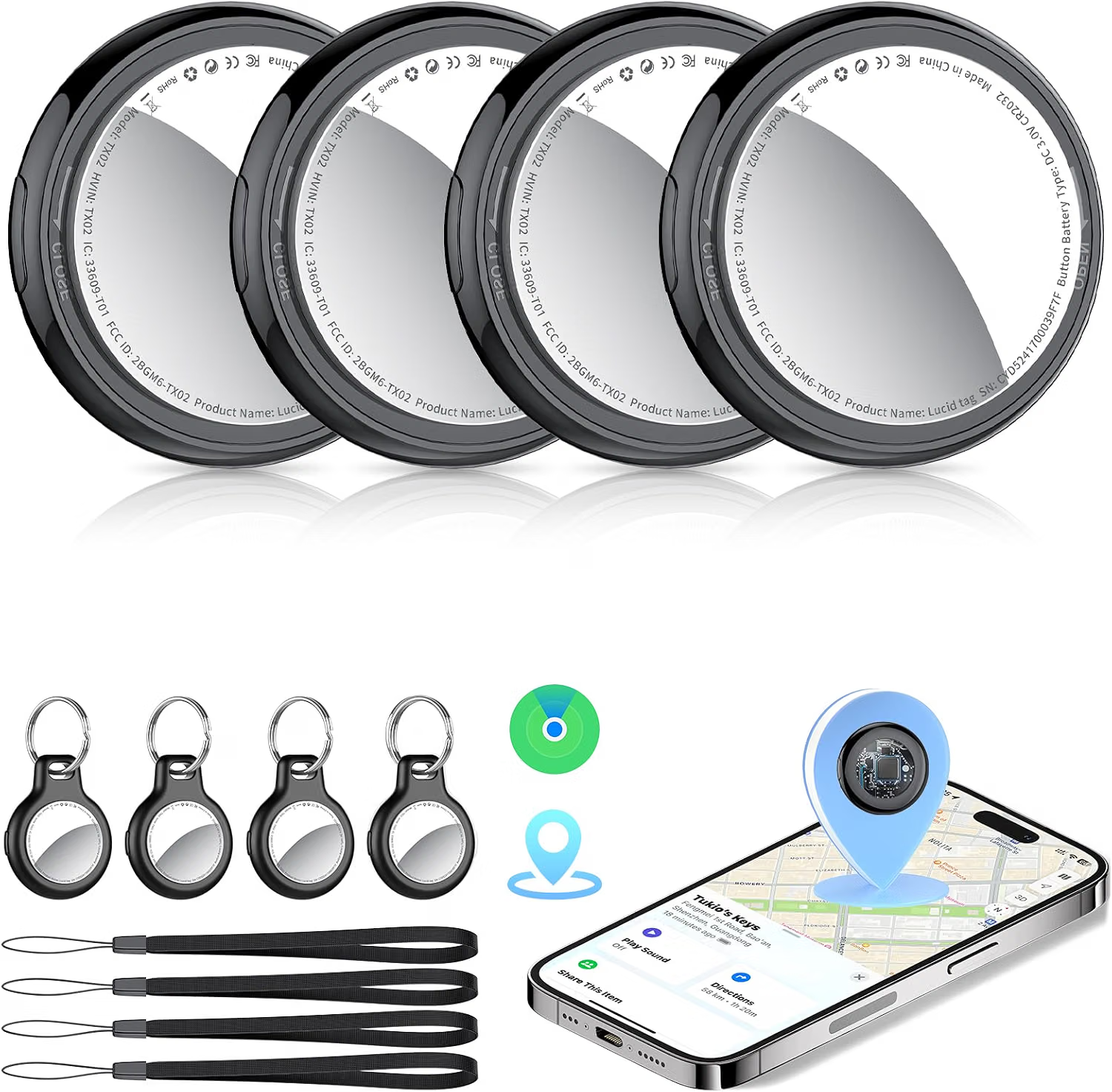
Bluetooth tracking tags are designed to address this type of situation. Instead of searching entirely by memory, a compatible smartphone can be used to help locate an item associated with a tracking tag. The Air Tracker Tags 4-Pack is an iOS-only key-finding product designed around this concept. The product listing identifies it as Apple MFi Certified and describes Bluetooth-based tracking with replaceable batteries.
A four-pack also allows several everyday objects to be tracked at the same time. Rather than purchasing and configuring a separate tracker for every item, users can assign individual tags to different belongings such as keys, bags, wallets, luggage, or other objects where the tag can be securely attached.
It is important to understand what a Bluetooth tracker actually does. A tracker of this type is not a miniature GPS device that continuously determines its own location from satellites. Instead, it communicates wirelessly with compatible devices and uses a supported tracking ecosystem to help users determine where a tagged object may be.
That distinction becomes especially important when considering range, indoor tracking, and situations where an item is no longer nearby.
The Air Tracker Tags described here are specifically intended for iOS users, which makes device compatibility one of the first considerations. An iPhone or compatible Apple device is an essential part of the intended ecosystem, and Android users should not assume that an iOS-only tracker will provide the same functionality.
This guide explains how this category of key finder works, what the four-pack format can be used for, how Bluetooth tracking differs from GPS, what Apple certification means in practical terms, and what users should consider before relying on a tracking tag for valuable or important belongings.
What Are Air Tracker Tags?
Air tracker tags are small electronic devices designed to help locate objects to which they are attached.
The tag communicates wirelessly with a compatible smartphone. When the user needs to find an item, the associated tracking system can provide information intended to help locate it.
A key point is that the tag does not replace the phone. The phone and the tracking ecosystem are part of the overall system.
This type of product is generally most useful for everyday objects that are frequently misplaced rather than for continuously monitoring a moving vehicle or person.
For example, a user might attach one tag to a set of keys and another to a backpack. If the keys are misplaced inside the house, the phone can be used to interact with the tracker and assist with the search.
The four-pack format expands this idea to several belongings.
Key Features
Four-Tag Package
The product is supplied as a four-pack, allowing users to track multiple objects.
This can be useful for households because different tags can be assigned to different family members or belongings.
A single user might also use all four tags for separate categories, such as:
- House keys
- Backpack
- Luggage
- Wallet or frequently misplaced accessory
The advantage of a multi-pack is flexibility. Once the tracking system is configured, each tag can have its own associated item.
Keeping a simple record of which tag is attached to which object can also help prevent confusion, particularly when several tags have similar physical appearances.
iOS Only
The product is specifically described as iOS only.
This is one of the most important compatibility considerations.
Users with iPhones or compatible Apple devices should verify the current system requirements before setup. Android users should not purchase an iOS-only tracker expecting full functionality through an Android smartphone.
Operating-system compatibility affects not only the initial setup but also the tracking ecosystem and available features.
Because software requirements can change, it is sensible to check the current product documentation before installation.
Apple MFi Certification
The product listing identifies the tracker as Apple MFi Certified.
MFi refers to Apple’s certification program for certain accessories designed to work with Apple products.
Certification can be relevant because it indicates that the accessory has been designed to meet applicable Apple requirements within the program.
However, certification should not be interpreted as a guarantee of every possible feature or as a statement that the product is identical to an Apple-branded device.
Users should still distinguish between accessory certification, compatibility, tracking functionality, and the capabilities of Apple’s own Find My ecosystem.
Bluetooth Connectivity
The tracker uses Bluetooth-based communication.
Bluetooth is useful for short-range wireless communication between the tag and compatible devices.
This allows a smartphone to interact with the tracker when it is within an appropriate communication range.
Real-world range varies depending on walls, objects, interference, device positioning, and environmental conditions.
For example, a tag inside a backpack in another room may behave differently from one sitting directly beside the phone.
This is why published Bluetooth range figures, where provided, should be understood as reference measurements rather than guaranteed performance in every environment.
Replaceable Battery
The product is described as using a replaceable battery.
This is a practical feature for a device designed to remain attached to an object for extended periods.
Instead of treating the tracker as disposable once its battery is depleted, users can replace the battery according to the manufacturer’s instructions.
Battery type and replacement procedures should be confirmed through the current product documentation.
Users should also keep replacement batteries stored safely, particularly in households with children or pets, because small button-cell batteries can be hazardous if swallowed.
Compact Key-Finder Design
The small format allows the tags to be attached to everyday objects without adding substantial bulk.
Keys, bags, luggage, and similar belongings can accommodate a compact tracker more easily than a larger electronic device.
The physical attachment method is nevertheless important.
A tracker only helps if it remains attached to the object it is intended to monitor. A loose or poorly secured tag can become another misplaced item.
How It Can Be Used
Finding Misplaced Keys
Keys are one of the most obvious applications.
A tracker attached to a key ring can help reduce the time spent searching for keys around the home.
Instead of checking every surface manually, the user can interact with the tracker through the compatible iOS ecosystem.
The effectiveness of this process depends on the phone connection, tracker battery, physical environment, and supported tracking functionality.
Tracking a Backpack
A backpack can move between home, work, school, gyms, and other locations.
Attaching a tracker to it can provide another way to identify its location through the supported tracking system.
This can be especially useful for people who frequently put bags down and later cannot remember where they left them.
The tracker should be placed securely inside or on the backpack where it is protected from accidental detachment.
Luggage During Travel
Travel introduces more opportunities for belongings to become separated from their owner.
A tracking tag can be attached to luggage to provide an additional way of identifying its location.
However, a Bluetooth tracker should not be treated as a substitute for airline baggage procedures or official lost-luggage processes.
It can provide useful location information within the capabilities of its ecosystem, but users should still follow the carrier’s procedures when baggage is delayed or missing.
Wallets and Small Accessories
Wallets are another common item that can be misplaced.
If the wallet design allows a tracker to be attached securely, the tag can provide an additional locating method.
The physical size of the tracker and attachment method should be considered because bulky accessories can be uncomfortable or impractical in a wallet.
Camera Bags
Photography equipment often travels between locations.
A tracker attached to a camera bag can help users keep track of the bag itself without attaching separate trackers to every piece of equipment inside it.
The same principle applies to laptop bags, work cases, instrument cases, and other frequently transported containers.
School Bags
Parents and students can use trackers on school bags where appropriate.
A tag can help locate a misplaced backpack or identify its last known location through the supported ecosystem.
Because tracking technology involves location information, users should consider privacy and responsible use, especially when devices are associated with children.
Travel Accessories
The four-pack format can also be useful for several travel items at once.
For example, tags could be assigned to luggage, a backpack, a camera bag, and another frequently transported item.
This creates a small tracking system rather than relying on one tracker for one object.
Understanding Bluetooth Tracking
Bluetooth tracking can sometimes be misunderstood.
A Bluetooth tracker is not normally designed to determine its location independently using GPS satellites.
Instead, it communicates with nearby compatible devices.
When the tracker is close enough to communicate directly with a user’s device, the connection can help with locating the object.
Some tracking ecosystems can also use networks of compatible devices to help update the location of a lost tracker when it comes into proximity with other participating devices.
The exact behavior depends on the ecosystem and supported features.
This means there are several different situations:
Nearby item: The phone may be able to communicate directly with the tracker.
Item outside direct Bluetooth range: The user’s phone may no longer communicate directly with it.
Tracker detected by another participating device: The tracking network may potentially update location information depending on the supported ecosystem.
Tracker with depleted battery: Wireless communication cannot continue normally until the battery is replaced.
Understanding these differences helps set realistic expectations.
Bluetooth Tracker vs. GPS Tracker
A Bluetooth tracker and a GPS tracker are designed for different purposes.
A GPS tracker generally determines location using satellite positioning and may communicate that information through cellular or other networks. This can make GPS systems appropriate for certain vehicles, equipment, or specialized tracking applications.
Bluetooth trackers are generally smaller, simpler, and designed around finding everyday objects.
They are particularly useful for belongings such as keys, bags, and luggage.
The right category depends on what needs to be tracked.
For ordinary household objects, a compact Bluetooth tracker may be more appropriate than a dedicated GPS system. For continuously monitoring a moving vehicle or other asset, a different technology may be required.
The Role of Apple’s Find My Ecosystem
For iOS-focused tracking accessories, the surrounding Apple ecosystem is an important part of the experience.
Compatible tracking products can interact with supported Apple services and devices in ways that extend beyond simple Bluetooth communication.
Users should verify exactly which Apple tracking features are supported by the particular tracker.
Not every third-party accessory necessarily has the same capabilities as Apple’s own AirTag, and certification does not mean that every feature is identical.
The most reliable approach is to consult the current product instructions and Apple’s documentation for supported accessory functionality.
Who It May Be Suitable For
iPhone Users
The most obvious audience is people who use compatible iOS devices.
Because the product is identified as iOS only, users should confirm their phone meets the current requirements.
People Who Frequently Misplace Small Items
Anyone who regularly spends time looking for keys, bags, or other belongings may find a tracker useful as an organizational tool.
The tag does not prevent an item from being misplaced, but it can add another method for locating it.
Travelers
Travelers may find multi-pack tracking useful for luggage and travel bags.
Having several tags available means different pieces of luggage or equipment can be associated with separate trackers.
Families
A four-pack can allow several household objects to be tracked simultaneously.
Families should establish who manages the associated tracking accounts and understand how location information is shared.
Students
Students who frequently carry backpacks, laptop cases, or sports bags can use trackers as an additional locating aid.
Parents should consider privacy implications before using tracking technology in connection with a child’s belongings.
People With Multiple Bags
Photographers, commuters, business travelers, and other people who regularly carry multiple bags can use separate tags for different cases.
This is one of the situations where a four-pack can be more practical than purchasing a single tracker.
Important Things to Consider
Compatibility Comes First
Because the product is iOS only, compatibility should be verified before purchase.
An Android phone should not be assumed to support the same functionality.
Check the current system requirements, supported Apple devices, and software requirements before setting up the tracker.
Battery Life and Replacement
A tracker is only useful while it has sufficient battery power.
Users should periodically check battery status when the system provides that information and replace the battery when necessary.
Keep replacement button-cell batteries away from children and pets.
Bluetooth Range
Bluetooth range is influenced by the environment.
Walls, floors, metal objects, furniture, electronic interference, and device placement can reduce communication distance.
Do not interpret a published range as a guarantee that the tracker will communicate reliably at exactly that distance in every building.
Not a Guaranteed Recovery System
A tracker can improve the chances of locating an item, but it cannot guarantee recovery.
An item may be damaged, inaccessible, moved to an area with limited network participation, have a depleted battery, or be outside the capabilities of the tracking ecosystem.
For valuable possessions, a tracker should be considered an additional layer of information rather than a guarantee against loss.
Privacy
Location-related technology deserves thoughtful use.
Tracking another person’s belongings without their knowledge can raise privacy and ethical concerns.
These devices are most straightforward when used for one’s own belongings or with the knowledge and consent of the people involved.
Families should establish clear expectations around tracking, especially when children or other household members are involved.
Security and Lost Items
If an item containing a tracker is lost in a public place, users should consider personal safety when attempting to recover it.
Location information can identify an approximate area without guaranteeing that the item is safely accessible.
If the tracking information suggests that a lost item is inside an unfamiliar private location, users should avoid confrontational situations and consider appropriate assistance.
Attachment Method
The tag must remain securely attached to the object.
A key ring, adhesive holder, pouch, or another attachment method may be appropriate depending on the item.
The attachment solution should not interfere with the tracker or create unnecessary bulk.
Physical Protection
Trackers can encounter dust, moisture, impacts, and temperature changes depending on where they are used.
Users should check the manufacturer’s specifications for water resistance, operating temperatures, and other environmental limitations rather than assuming that every tracker is suitable for outdoor exposure.
Multiple Tags Need Organization
A four-pack introduces a small organizational challenge.
If all four trackers look similar, users can forget which tag belongs to which item.
Adding an appropriate label or maintaining a simple list in the tracking system can help.
Air Tracker Tags vs. Apple AirTag
Third-party iOS-compatible tracking tags and Apple’s AirTag occupy similar general categories, but they are not necessarily identical products.
Apple’s AirTag is an Apple-designed tracker built around Apple’s own ecosystem.
The product discussed here is a third-party accessory that is identified as Apple MFi Certified.
Users should compare the actual supported features, compatibility, battery type, physical design, tracking-network support, privacy features, and software requirements rather than assuming that certification makes two products equivalent.
The important question is which functions are actually supported by the specific accessory.
Air Tracker Tags vs. Generic Bluetooth Key Finders
Generic Bluetooth key finders can use different smartphone applications and tracking ecosystems.
Some may support both iOS and Android, while others are designed around one operating system.
The advantage of an iOS-specific accessory can be ecosystem integration, while a universal tracker may be more appropriate for households using different smartphone platforms.
Compatibility should be considered before physical design or price.
Air Tracker Tags vs. GPS Trackers
GPS trackers generally serve a different purpose.
They can be designed to determine location independently through satellite positioning and may use cellular communication.
That functionality can require larger hardware, more power, and potentially ongoing service requirements.
Bluetooth tags are generally more suited to small everyday objects.
For keys and bags, a compact Bluetooth tracker may be practical. For vehicles or continuously moving assets, a GPS-based solution may be more appropriate.
Air Tracker Tags vs. Phone-Based Location Sharing
Location sharing through a smartphone can help people locate each other or coordinate activities, but it does not solve the same problem as attaching a tracker to an object.
A phone belongs to a person.
A tracker belongs to an item.
This distinction makes Bluetooth tags useful for objects that do not have their own internet connection or location system.
Setting Up a Four-Tag System
A multi-tag system works best when it is organized from the beginning.
Start by assigning each tag to one specific object.
For example:
Tag 1: House keys
Tag 2: Main backpack
Tag 3: Travel luggage
Tag 4: Camera or laptop bag
Follow the manufacturer’s instructions for pairing each tag with the supported Apple ecosystem.
Once each tag is associated with an item, verify that the names or descriptions are easy to recognize.
Testing each tag immediately after setup can also help identify connection or compatibility problems before the tracker becomes important.
Everyday Habits That Make Tracking More Useful
A tracker works best when it becomes part of a normal routine.
Attach the tag securely and avoid moving it between different belongings unnecessarily.
Check battery status periodically.
Keep the associated iPhone updated according to normal software practices.
If a tracker becomes disconnected, investigate the issue rather than assuming the item is lost.
It can also be helpful to establish a simple rule: important everyday objects should return to the same location after use.
Technology can assist with recovery, but organization can reduce the frequency of misplaced belongings in the first place.
Travel Considerations
Tracking tags can be useful when traveling, but users should understand their limitations.
Before a trip, confirm that the tracker is connected and that the battery has sufficient charge.
Place the tag securely inside or on the luggage.
If baggage becomes separated from the owner, the tracking system may provide useful location information depending on the available network and device interactions.
However, travelers should still use airline baggage tags, claim procedures, and other standard methods.
A tracking tag should be considered an additional tool rather than an official baggage-management system.
Frequently Asked Questions
What are Air Tracker Tags?
Air Tracker Tags are small Bluetooth-based devices designed to help users locate belongings through a compatible smartphone and tracking ecosystem.
Are these tracker tags compatible with Android?
The product is described as iOS only. Android users should not assume that the same functionality is available on Android devices.
How many tags are included?
The product is sold as a four-pack, allowing up to four separate belongings to be associated with individual tags.
What does Apple MFi Certified mean?
MFi certification refers to Apple’s accessory certification program. It indicates that the accessory has been designed and certified according to applicable Apple requirements within that program. It does not mean that the third-party tracker is an Apple-branded AirTag or that every Apple feature is necessarily identical.
Do the tags use Bluetooth?
Yes. The product is designed around Bluetooth connectivity for communication with compatible devices.
Are these GPS trackers?
They should not be treated as conventional GPS trackers. Bluetooth tracking and GPS tracking use different technologies and are designed for different use cases.
Can I use one tracker for my keys?
Yes. A key ring is one of the common applications for a compact Bluetooth tracking tag.
Can the tags be used with luggage?
They can be attached to luggage as an additional way of helping identify or locate a bag through the supported tracking ecosystem.
What happens when the battery runs out?
Wireless tracking functionality will generally be unavailable while the battery is depleted. The product is described as using a replaceable battery, so users can replace it according to the manufacturer’s instructions.
Can four tags be used at the same time?
The four-pack is designed to provide four individual trackers, allowing users to assign separate tags to different belongings.
Does Bluetooth range work through walls?
Bluetooth signals can pass through some obstacles, but walls, floors, furniture, metal structures, and electronic interference can reduce effective range.
Can the tracker guarantee that I will recover a lost item?
No. A tracking tag can provide additional locating information, but it cannot guarantee recovery. Battery condition, connectivity, network availability, physical access, and other factors can affect the outcome.
Can I track another person with these tags?
These products are designed primarily for locating belongings. Tracking another person’s possessions without their knowledge can raise privacy concerns. Responsible use should involve the knowledge and consent of the people involved where applicable.
Are Bluetooth trackers useful for travel?
They can be useful as an additional way to monitor luggage and travel bags, but they should not replace standard baggage identification or airline procedures.
Do I need an iPhone to use the product?
Because the product is identified as iOS only, a compatible Apple device is part of the intended setup. Users should verify the current compatibility requirements before use.
Should I replace the battery regularly?
Battery replacement depends on actual battery life and usage. Users should monitor battery status when supported and replace the battery when necessary according to the manufacturer’s instructions.
Are Bluetooth trackers better than GPS trackers?
They serve different purposes. Bluetooth trackers are generally designed for small everyday belongings, while GPS trackers are intended for applications where independent location determination and broader connectivity may be needed.
Conclusion
The Air Tracker Tags 4-Pack is designed to provide an iOS-focused way of keeping track of everyday belongings through Bluetooth connectivity. With four individual tags, users can assign separate trackers to keys, backpacks, luggage, camera bags, laptop cases, or other frequently misplaced items.
The iOS-only design makes compatibility one of the first things to consider. Apple MFi certification is also an important part of the product’s positioning, although it should not be confused with being an Apple-branded product or with automatically having every feature offered by Apple’s own tracking hardware.
The replaceable-battery design can make the tags suitable for longer-term use, while the compact form factor allows them to be attached to many everyday objects. Bluetooth communication provides the underlying connection, but real-world range depends on the surrounding environment and should not be treated as a guaranteed distance.
Perhaps the most important concept is understanding what this type of tracker can and cannot do. A Bluetooth tag is not the same thing as a GPS tracker. It is primarily an accessory for locating belongings through a compatible tracking ecosystem. Depending on the supported network and circumstances, it may help users find an item nearby or provide location information when the tag interacts with other participating devices.
For everyday organization, that distinction can still be valuable. Keys, bags, luggage, and other objects do not have their own location systems, so adding a small tracker can provide an extra layer of visibility when something goes missing.
At the same time, users should maintain realistic expectations. A tracker cannot guarantee recovery, and its usefulness depends on battery power, compatibility, wireless communication, network availability, physical attachment, and the capabilities supported by the associated ecosystem.
Privacy should also remain part of the conversation. Tracking technology is most appropriate when used responsibly for personal belongings or with the knowledge and consent of the people involved.
For iOS users looking to organize several everyday belongings within a Bluetooth-based tracking system, a four-pack provides the flexibility to monitor multiple items at once. Before setting up the tags, users should confirm current Apple compatibility requirements, supported tracking features, battery specifications, and manufacturer instructions.
Leave a Reply